Humans have been gardening for thousands of years, and apparently we have spent a good chunk of that time inventing increasingly elaborate ways to avoid doing repetitive jobs by hand. Some of those inventions are brilliant. Some look like props from a horror movie. A few are almost exactly what we still use today.
From hooked pruning blades to Victorian cucumber straighteners, these old-school gardening tools reveal something familiar: somebody had a problem in the garden, got tired of it, and built a tool specifically to fix it.
The real question is not just whether they worked back then. It is whether Jacques and I would want them in the garden now.
Table of Contents
- 1. Spring-Loaded Mole Traps: Pest Control With Serious Attitude
- 2. The Dacian Falx: Somewhere Between a Pruning Tool and a Sword
- 3. The Seed Fiddle: A Human-Powered Broadcast Spreader
- 4. The Cast-Iron Corn Sheller: A Purpose-Built Tool We Could Have Used
- 5. The Victorian Cucumber Straightener: All That Effort for a Sandwich
- 6. Roman and Medieval Dibbers and Mattocks: Hard to Improve on a Good Idea
- 7. The Double Wheel Hoe: Work Both Sides of the Row
- 8. Victorian Powder Bug Guns: Clever Bellows, Questionable Dust Clouds
- 9. Berry Picking Cans: The Tool We Call the Booper
- Which Old Gardening Tools Deserve a Comeback?
1. Spring-Loaded Mole Traps: Pest Control With Serious Attitude
We are kicking things off with a doozy. A nineteenth-century spring-loaded mole trap, complete with a row of long metal spikes, looks less like garden equipment and more like something a movie villain would attach to an arm.
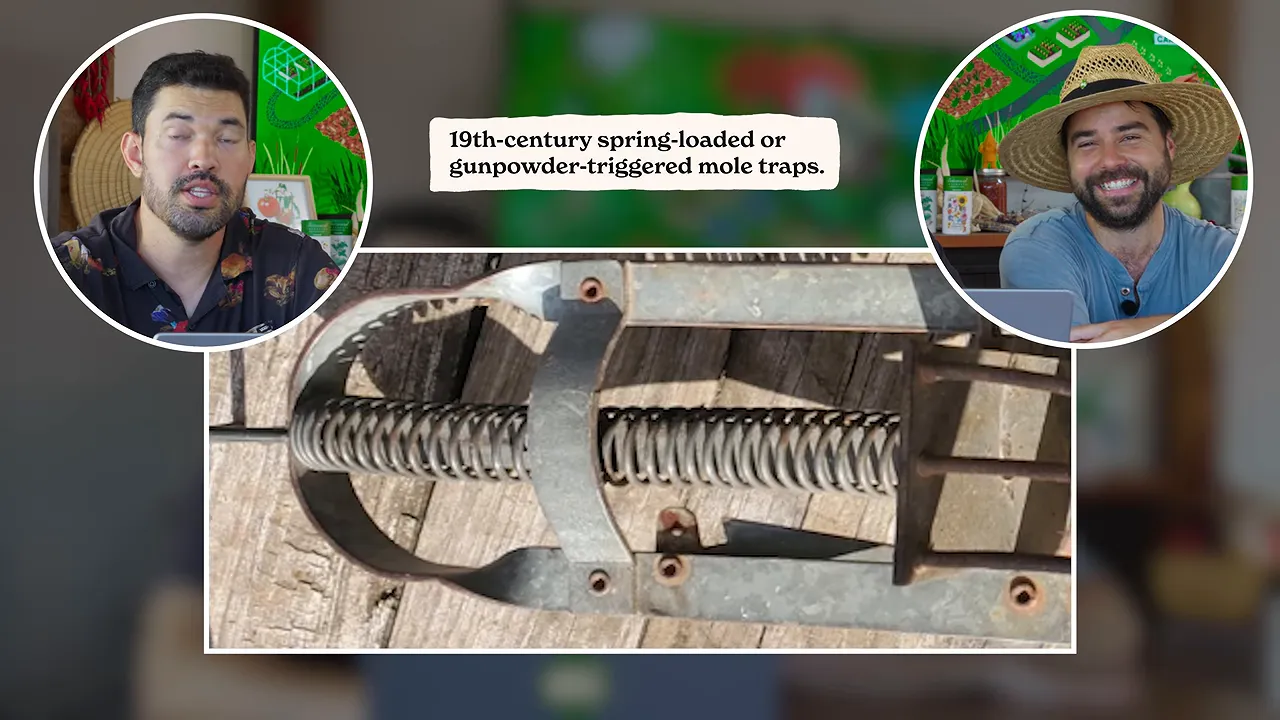
The basic idea is straightforward: a trigger releases the mechanism, driving the spikes downward into the soil. We have bought modern traps that look recognizably similar. What we have not needed in our pest-control routine is gunpowder.
Yes, gunpowder-triggered traps were part of this historical lineup, too. The separate example demonstrated was a mouse trap, not a mole trap, an important distinction. Its action was so fast that it was difficult to make out the movement. Our discussion of how that might translate to an underground trap was speculation, not a tested explanation.
It is easy to laugh at how extreme these devices look, but the frustration behind them is familiar. Gophers can be incredibly destructive. I have lost fruit trees that had been growing for years, so I understand reaching the point of wanting decisive control.
Our take: We understand the appeal of an effective trap. That does not make an antique gunpowder mechanism a sensible backyard experiment.
2. The Dacian Falx: Somewhere Between a Pruning Tool and a Sword
The Dacian falx has an immediate presence. Picture a long blade with a pronounced hook, somewhere between a machete, a sword, and a scythe. It is the sort of thing you would be excited to own and slightly nervous to have delivered.
The historical examples discussed stretch from roughly 200 BCE to 400 CE, with agricultural uses associated with vineyard workers and orchard keepers. The hooked shape is the interesting part for a gardener: it offers a way to draw vegetation toward you and cut with a pulling motion rather than relying only on a straight chop.
That makes mechanical sense. A hook can help gather or position a vine or branch, while the curved blade supports a drawing cut. Looking at the different forms, you can see why the conversation quickly shifts from pruning to warfare. The agricultural and military associations are part of what makes this tool so striking.
In a cutting demonstration, a modern version went through a substantial branch with a chopping motion that also included a downward pull. We disagreed about the branch’s exact thickness, but not about the result: it was impressive.
A reproduction listing we found was about $254 at the time. That is a lot more than a pair of pruners, but admittedly, pruners do not have quite the same dramatic entrance.
Our take: Two enthusiastic thumbs up for the design and a strong desire to try one. It is still a serious blade, not a casual replacement for every pruning job.
3. The Seed Fiddle: A Human-Powered Broadcast Spreader
If you handed me a seed fiddle without an explanation, it might take me a very long time to figure out what to do with it. It looks part musical instrument, part mysterious wooden contraption.
Once you understand the mechanism, though, it is fantastic.
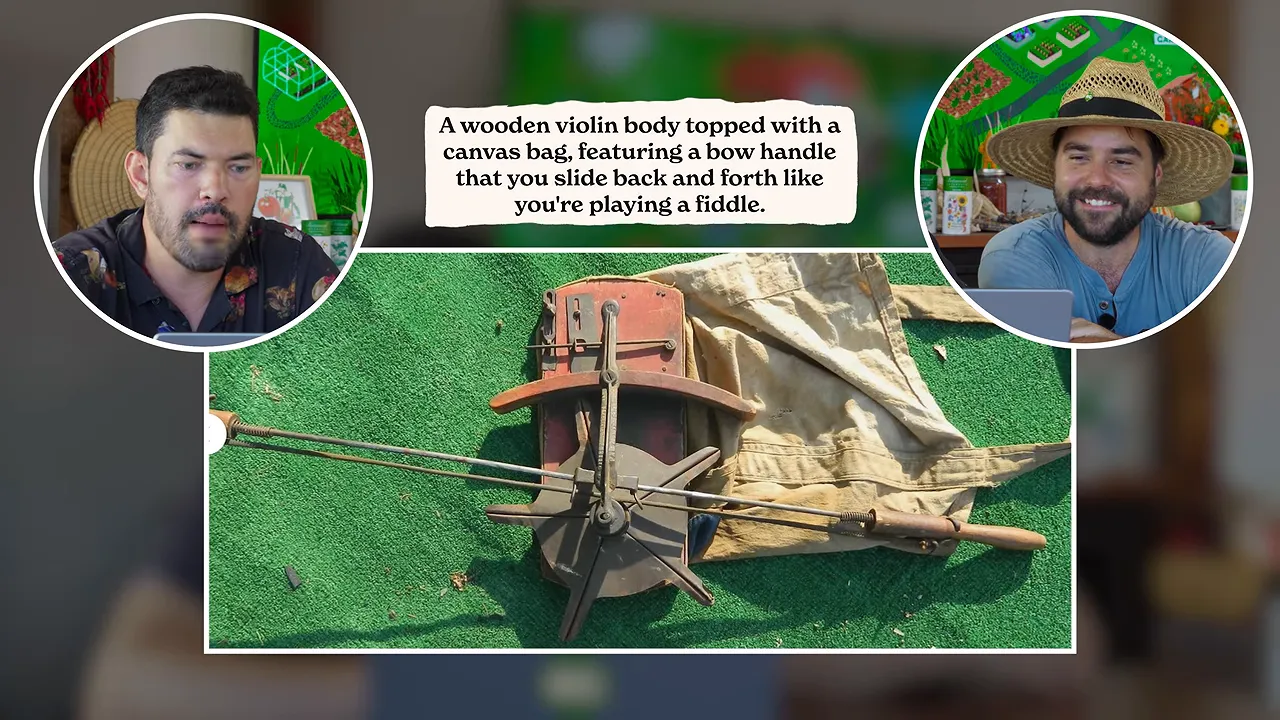
The device combines three main elements:
- A canvas bag or hopper that holds the seed.
- A wooden body that supports the mechanism.
- A sliding bow handle that powers a small spinning fan or paddle beneath the hopper.
You move the bow back and forth as though playing a fiddle. That motion drives the spreading mechanism, which broadcasts seed outward. The design described could distribute seed in an arc of about 20 feet.
Essentially, it is a Victorian seed spreader powered by your arm. Instead of tossing handfuls across a field, you walk and keep the bow moving.
What I love is how much the mechanism accomplishes without a motor. It is not especially complicated once you can see it working, but somebody still had to connect that back-and-forth motion to a useful spinning action.
Our take: Absolutely here for it. This is clever mechanical problem-solving, and the basic job remains relevant.
4. The Cast-Iron Corn Sheller: A Purpose-Built Tool We Could Have Used
When we made tortillas from our own corn, we discovered that getting kernels off the cob by hand is real work. A cast-iron corn sheller would have saved us a lot of time and some very tired fingers.
Although the tool was introduced as a sheller grinder, the function being demonstrated was shelling, not grinding. Those are separate jobs. This machine removes kernels from the cob; it does not turn them into flour or masa.
You feed an ear into the opening and turn the handle. Metal teeth knock the kernels free, while the mechanism separates and ejects the stripped cob. It is a simple idea with an enormously satisfying result.
There is also an unexpected second use: some antique-tool enthusiasts repurpose these shellers to remove the tough green or dark outer hulls from black walnuts. That is the outer hull, not the hard shell surrounding the nutmeat.
I know single-purpose tools get criticized, especially in kitchens, but I love a tool designed to solve one annoying problem really well. You can almost picture the inventor sitting beside a pile of corn, deciding that enough was enough.
And if you are growing enough corn to depend on it for food, shelling efficiency is not a novelty. It matters.
Our take: A very practical tool for the right harvest volume. Also, with the walnut connection, we can officially defend it as a two-purpose tool.
5. The Victorian Cucumber Straightener: All That Effort for a Sandwich
A cucumber straightener sounds like a joke until you see one. It is a long glass tube placed around a developing cucumber so the fruit grows within a straight-sided enclosure.
The motivation was presentation. Think neat cucumber slices and carefully assembled Victorian tea sandwiches, not simply getting something edible out of the garden.
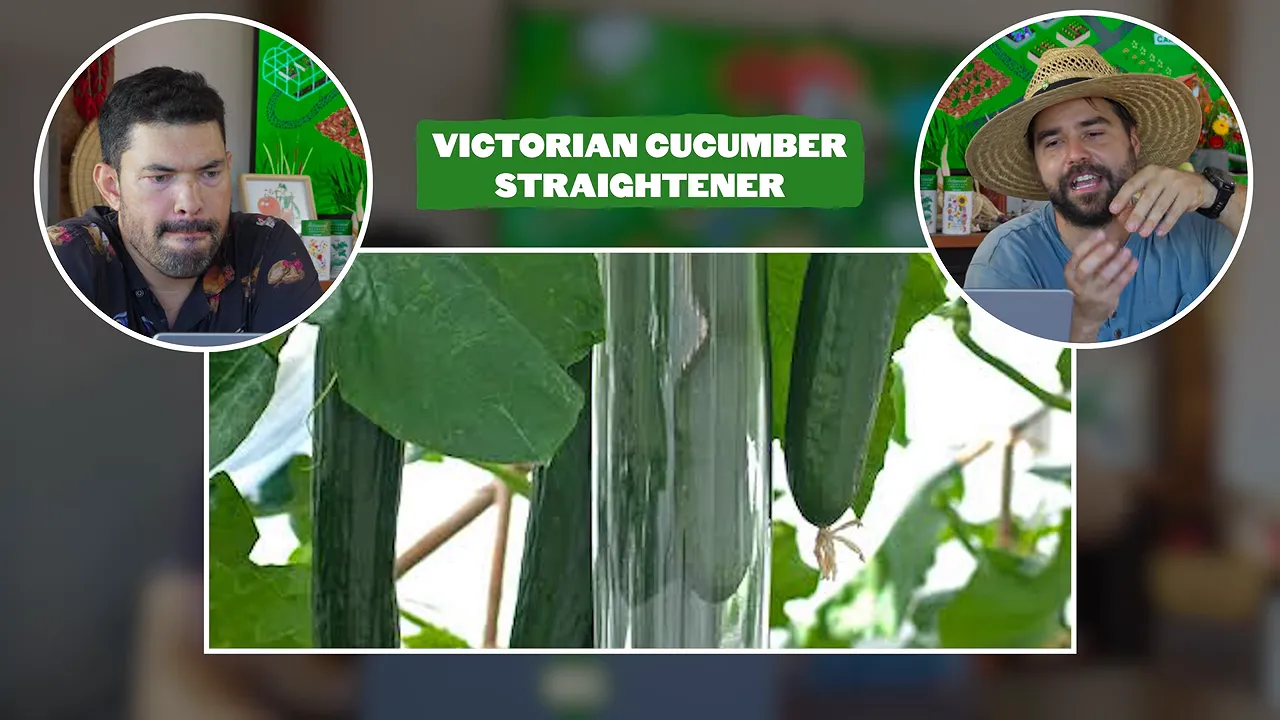
The mechanism is a growing mold rather than something you use after harvest. The young cucumber goes inside the tube, and the enclosure constrains its shape as it expands and lengthens. An open end makes the design much more practical than a sealed bottle that would have to be broken.
It is the same broad idea behind novelty molds that shape squash or pumpkins into faces. Instead of asking the plant to grow differently on its own, you give the developing fruit a physical boundary.
We suspect modern breeding has reduced the need for this kind of intervention. Straight cucumbers feel ordinary now, which makes the historical effort especially funny. A tidy cucumber could once justify its own specialized piece of glassware. Today, we might barely give that same cucumber a second thought.
And honestly, if it is getting sliced into a sandwich anyway, how much does the curve matter?
Our take: We love the ingenuity more than we feel a pressing need to straighten our cucumbers.
6. Roman and Medieval Dibbers and Mattocks: Hard to Improve on a Good Idea
Some old tools look strange because the task has changed. Others look familiar because the task has barely changed at all.
Dibbers and mattocks fall firmly into that second group.
A dibber, also called a dibbler, punches planting holes. A hand-forged iron version might look crude at first glance, but it serves a clear purpose: turning the pressure of your hand into a more effective way to make a hole.
A mattock is for heavier soil and root work. It is one of those tools we still genuinely appreciate in the garden. Digging trenches, working out stubborn roots, and tackling Bermuda grass are all jobs where it earns its keep.
Jacques once dealt with a couple of fence posts in the backyard in a matter of hours. Give him a stubborn digging job and a useful tool, and he is pretty happy.
Looking at these old iron heads, what stands out is how recognizable they are. You can see the opening for a wooden handle. You can understand the working edge. You do not need an elaborate explanation to imagine putting one to use.
Modern versions may have longer handles or a pick on the opposite side, but the underlying concept is familiar.
Our take: Would happily use the design. When a tool already gives you the leverage and working edge you need, there may not be much to reinvent.
7. The Double Wheel Hoe: Work Both Sides of the Row
The double wheel hoe is another design that feels immediately useful. Two wheels support a frame that can straddle a crop row, with working implements positioned to cultivate or move soil beside the plants.
The appeal is continuous motion. Instead of making every hoe stroke separately, you push the tool along the row and let the attached implements do the work.
Depending on the attachment and arrangement, the tool can cut into the ground, cultivate weeds, or move soil back toward the row. The modern demonstration showed soil being mounded around corn.
That immediately got us thinking about other possible applications:
- Potatoes, where moving soil toward the row could be useful.
- Leeks, which particularly caught our attention as a potential fit.
- Other row crops, where the right cultivating attachment could work beside the plants.
The open center is a major advantage. Within the limits of the frame’s clearance, plants can pass through the middle while the tool works on either side. You are not dragging a solid crosspiece directly through the crop.
Our take: An excellent concept that still has a place in a garden organized around accessible rows. Old-school does not mean obsolete.
8. Victorian Powder Bug Guns: Clever Bellows, Questionable Dust Clouds
These look like something out of a cartoon, but the mechanism is easy to understand once you compare it to fireplace bellows.
A container holds powder. Pumping the bellows pushes air through the device, carrying some powder with it and sending out a puff or cloud.
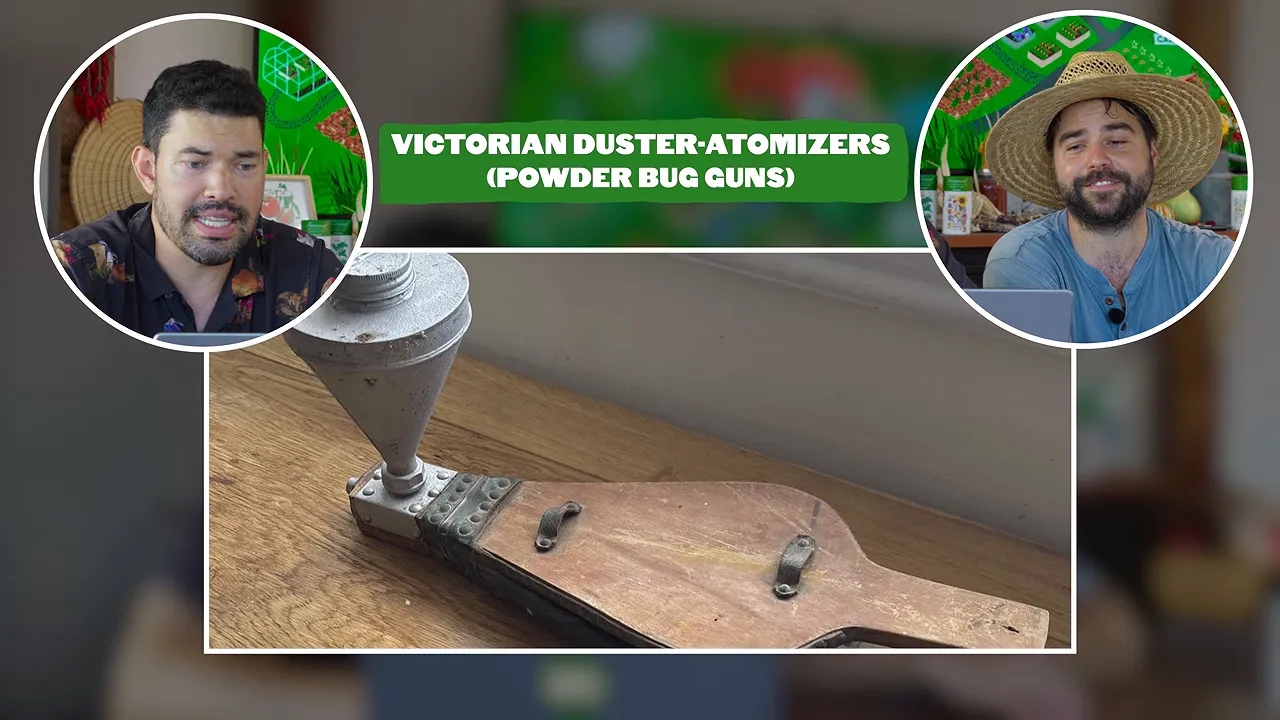
Historical garden dusters were used to distribute materials such as copper dust or sulfur powder over plants for pest and disease control. Rather than applying a liquid spray through a nozzle, the gardener distributed a dry material in moving air.
Jacques has used a frustrating modern plastic version for diatomaceous earth, so the substantial old bellows design has a certain appeal. You can imagine it moving air more effectively, although we did not test that comparison.
The obvious problem is the airborne dust. An effective delivery mechanism does not automatically make the application safe, especially when the operator is standing right beside the cloud.
The mechanism is worth appreciating; casual exposure is not worth copying. Anyone using a current garden pesticide should follow its label, including application restrictions and required protective equipment. The EPA’s guidance on safe pest control provides useful supporting information.
Our take: Mechanically interesting, but this is where enthusiasm needs a serious dose of caution.
9. Berry Picking Cans: The Tool We Call the Booper
Here is one we already own, although we have given it a better name: the booper.
You may know it as a berry rake, berry scoop, cranberry scoop, or berry picking can. The basic design combines a collecting box with a row of projecting tines. Those tines comb through the crop, helping detach the harvest and direct it into the container.
Older versions used wood and metal. Locally made tools could incorporate tin cans, wire, or nails for teeth. Ours has a plastic body and metal tines, but the working principle is essentially the same.
Blueberries were one of the first uses we had in mind, particularly the dense picking associated with low-growing wild blueberries. A blackberry demonstration also showed an application we had not considered.
But our favorite use has been harvesting chamomile flowers. For that job, this thing is amazing.
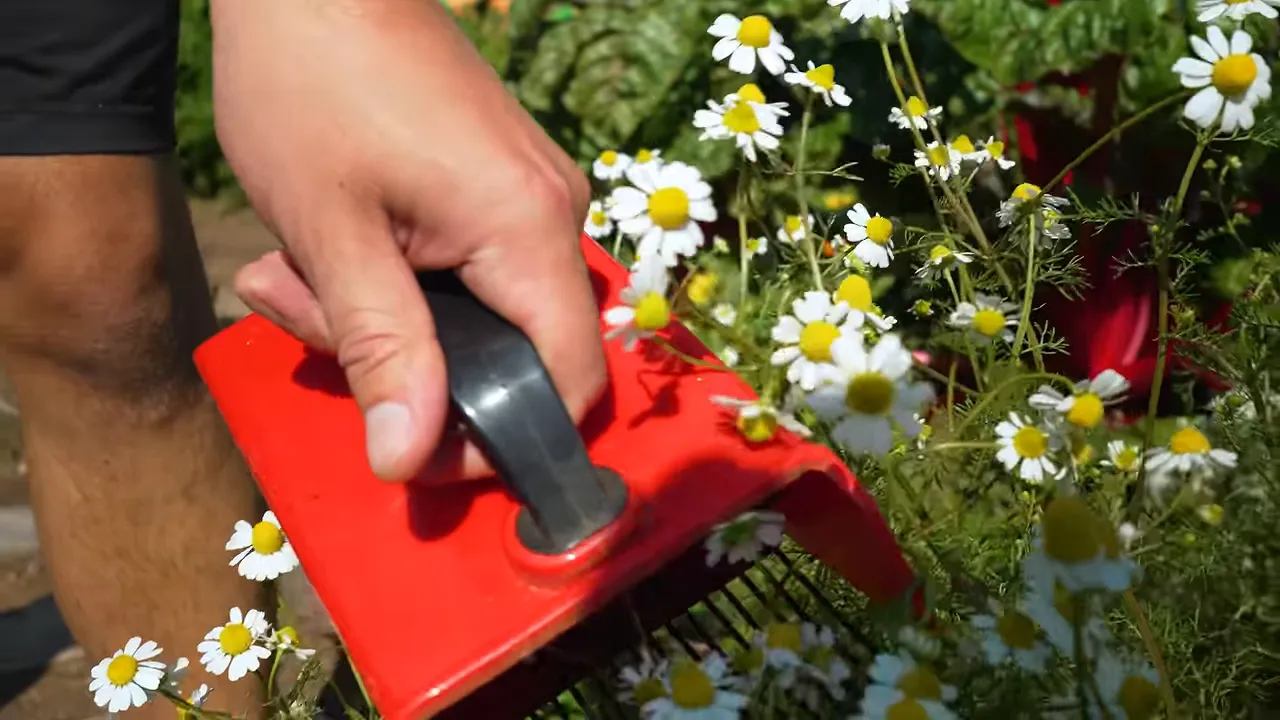
There is something deeply satisfying about the little pulling motion as the scoop gathers the flowers. That feeling is part of how it earned its nickname, but the practical benefit is what keeps it in use.
Our take: Already in the garden, already useful, and proof that a simple harvesting design can survive a change in materials without needing a complete redesign.
Which Old Gardening Tools Deserve a Comeback?
The strongest designs here have something in common: they make a repetitive task easier through a clear mechanical advantage. The seed fiddle turns arm movement into broad seed distribution. The sheller replaces tedious finger work. The wheel hoe turns separate strokes into steady forward progress. The berry scoop gathers multiple flowers or fruits in one pass.
Some tools never really left. Mattocks, dibbers, wheel hoes, and harvesting scoops are still around because the jobs they solve are still around.
Others are more interesting as objects of curiosity. I can admire a cucumber straightener without needing perfectly cylindrical cucumbers. And I can understand the frustration behind an antique pest trap without bringing gunpowder into the garden.
The lesson is not that everything old was better. It is that gardeners have always been inventive, practical, and occasionally a little dramatic. Give us enough corn to shell or enough weeds to hoe, and sooner or later somebody is going to build a contraption.


