Bury a fish head beneath your tomatoes. Drop an egg into the planting hole. Tuck kitchen scraps under the roots and let the soil do its thing.
These are classic gardening recommendations, but do they actually produce more tomatoes? And does it matter whether you bury vegetable trimmings, garden weeds, or last week’s pasta?
We put those ideas to the test with six Italian Roma tomato plants, five different buried amendments, and one plant with nothing added at all. About three months later, we counted the tomatoes, weighed the harvests, and dug up the planting holes to see what remained.
After more than a decade of gardening, I still wasn’t prepared for some of these results. The fish heads finished last, the eggs produced the heaviest harvest, and the plain old control delivered by far the most ripe tomatoes. The most useful lesson, though, was what happened between burying those scraps and harvesting the fruit.
Key Takeaways
- The egg treatment produced the heaviest harvest, while the control produced the most ripe tomatoes.
- Whole catfish heads beneath a transplant produced the lowest tomato yield in this backyard trial.
- Decomposition by season’s end did not guarantee that buried scraps benefited the growing tomato.
- Particle size and nutrient-release timing matter when evaluating raw scraps as garden amendments.
Table of Contents
- How We Set Up the Kitchen Scrap Experiment
- Two and a Half Weeks Later: The Fish Tomato Fell Behind
- One Month In: Particle Size Became the Big Question
- Two Months In: Bigger Plants Didn’t Necessarily Mean Better Harvests
- The Final Harvest: Eggs Won on Weight, Nothing Won on Ripeness
- Digging Up the Scraps: What Was Still Underground?
- What This Experiment Can and Cannot Tell Us
- Would I Bury Kitchen Scraps Under Tomatoes Again?
How We Set Up the Kitchen Scrap Experiment
This was a backyard experiment, not a laboratory trial. Still, we wanted to control as many variables as we reasonably could. If one tomato received more water, different soil, or a head start, comparing the scraps wouldn’t tell us much.
Six tomatoes, five amendments, and a control
We gave every plant a name to keep the treatments straight:
- Tahini: Prepared kitchen leftovers, including old sourdough starter, tahini pasta, and cooked beans.
- Oxalis: Garden clippings and weeds collected around the garden.
- Noodle: Catfish heads and fillets, including three whole heads.
- Scrappy: Food preparation scraps, including cabbage, pepper trimmings, apple cores, and coffee grounds.
- Eggbert: Several eggs, with one left whole and the others cracked into the hole.
- Roma: Our control, planted without any buried amendment.
The distinction between Tahini and Scrappy matters. One received prepared food, while the other received the bits left over from preparing food.
Keeping the growing conditions consistent
All six plants were Italian Roma tomatoes grown from Botanical Interests seed. We started them at the same time, in the same soil, using the same seed-starting trays and growing conditions. They were close in size at transplanting, although not perfectly identical.
We loosened the planting row with a broadfork and added no fertilizer. The tomatoes went about 2 feet apart to reduce the chance that the contents of one planting hole would affect its neighbor.
For irrigation, we installed two lengths of drip tape, one about 6 inches to either side of the plants. A timer ran the system for one hour twice a week. That was our experimental schedule, not a universal tomato-watering recommendation.
We also used steel mesh baskets in the planting holes. Gophers could have disturbed the buried material and ruined the comparison, so protecting the holes was part of keeping conditions consistent.
Planting over the scraps
We buried the amendments about 12 inches deep, covered them with soil, and planted the tomatoes above them. Each plant received a bamboo stake for early support and an initial hand watering that we tried to keep as even as possible.
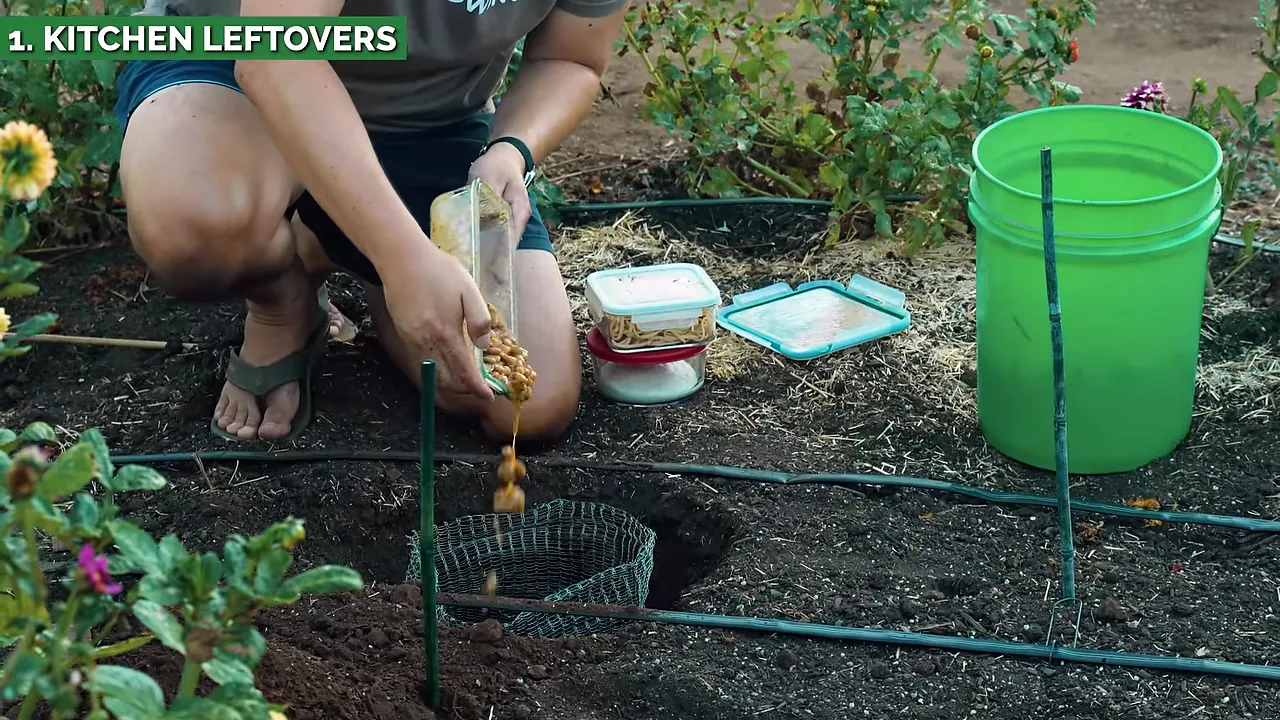
With the garden clippings, I deliberately avoided packing in an enormous amount. A thick, compressed mat of green material was exactly the sort of thing I worried could create oxygen-poor conditions.
Later, we gave all six plants taller supports and tied up their main stems. These were determinate tomatoes, and we did not prune them. We let the plants branch and sprawl while treating them as consistently as possible.
Two and a Half Weeks Later: The Fish Tomato Fell Behind
At the first check, Tahini, Oxalis, and Scrappy looked remarkably similar. They had comparable height and bushiness, with developing flower clusters but no obvious fruit set yet.
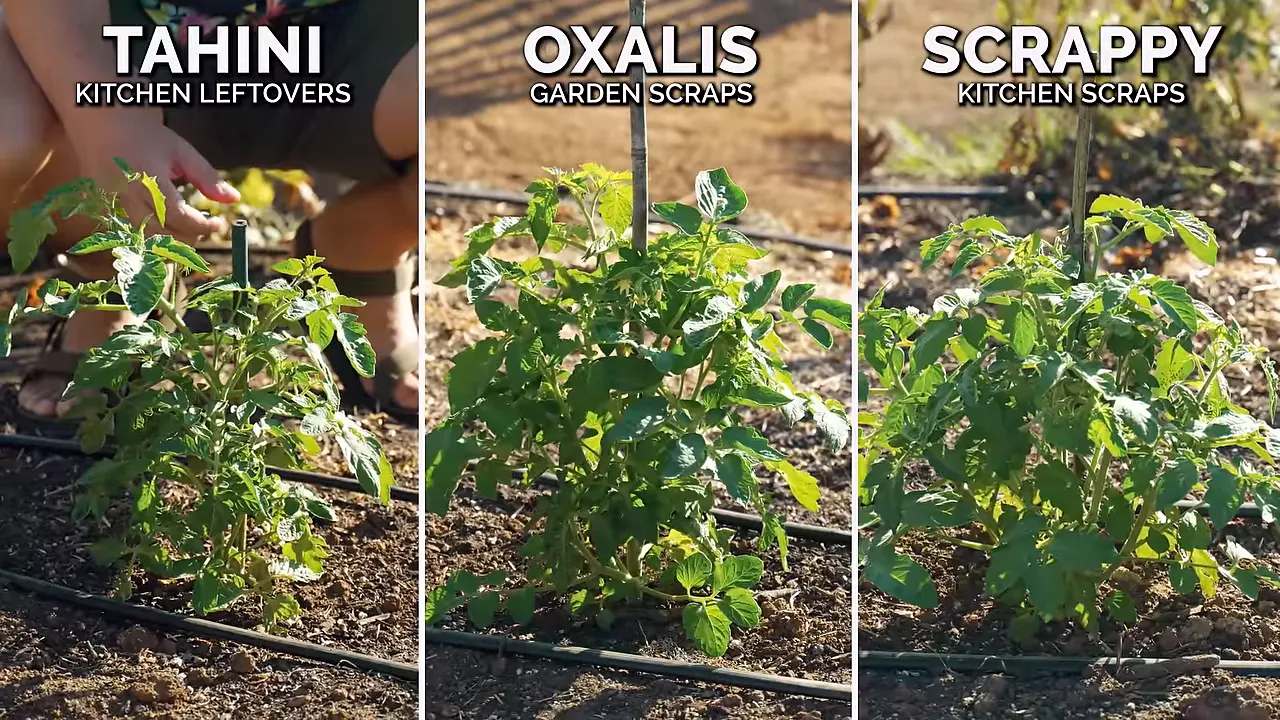
Noodle, our catfish tomato, was a different story. It was clearly behind, with fewer side shoots and a much smaller canopy. It was forming some flowers, but the plant simply wasn’t filling out like its neighbors.
That surprised me. Burying fish beneath crops is such a familiar recommendation that I expected this plant to be competitive.
My early suspicion was that the fish heads were taking time to break down into nutrients the tomato could use. Perhaps decomposition was also creating a temporarily acidic or oxygen-poor pocket beneath the plant. Those were possibilities, not measurements. We weren’t testing soil oxygen or pH inside the holes.
Meanwhile, Eggbert and the control were the bushiest plants in the row. At that stage, they looked almost like twins.
More leaves can give a tomato more capacity to capture sunlight through photosynthesis. That made their early growth encouraging, although a large canopy alone wouldn’t tell us which plant would produce the best harvest.
I also wondered whether most of the egg whites and yolks might already have decomposed, leaving mainly shells. If so, Eggbert could have been behaving more like the control than I had expected. We would have to wait until the final excavation to find out.
One Month In: Particle Size Became the Big Question
About 10 days later, the plants had also received roughly 1 to 2 inches of rain from storm Hilary passing through San Diego. They were still growing, and the size differences remained noticeable.
I asked Jacques to assess the plants before telling him which amendment was buried where. Like many gardeners, he expected the fish treatment to land somewhere near the top. Instead, it was still the smallest.
That pushed our discussion toward two closely related ideas: particle size and surface area.
A whole fish head is a large piece of organic material. Decomposers have to work through it. A collection of chopped vegetable scraps offers many more exposed surfaces relative to its volume, giving decomposers more places to get started.
It is the same basic consideration that comes up in composting. Big pieces and small pieces don’t necessarily break down at the same rate.
That doesn’t prove surface area caused the differences in our row. The treatments also differed in composition and amount. But it gave us a better question than simply asking which scrap contained the most nutrients:
Could those nutrients become available at the right time, without creating unfavorable conditions around the roots?
Two Months In: Bigger Plants Didn’t Necessarily Mean Better Harvests
By mid-September, nearly every treatment had fruit. The plants were also growing into one another, making it harder to judge their individual canopies.
Tahini, the prepared-leftovers tomato, now appeared to be the smallest overall plant. Oxalis, on the other hand, had really come along. The garden-scrap treatment looked healthy and vigorous.
Noodle still had a smaller canopy, but it carried a respectable-looking collection of tomatoes and more flowers. For a moment, it seemed possible that the fish treatment might recover through fruit production rather than leafy growth.
We wondered whether the fish’s nutrient profile could explain that pattern, but we didn’t have nutrient measurements to support that explanation.
At the other end of the row, Eggbert and the control had grown together into a tangle. The control also appeared to have the most aphids. There were some on several plants, while we couldn’t find any on Oxalis during that inspection.
That was interesting, but not evidence that buried weeds prevent aphids. We had no way to establish why the pest levels differed.
A few tomatoes were ripening, but we left the fruit in place for a single final comparison. We wanted to count and weigh everything plant by plant, rather than make a judgment based on how impressive the foliage looked.
The Final Harvest: Eggs Won on Weight, Nothing Won on Ripeness
At the end of the experiment, we removed all the tomatoes and separated each plant’s fruit from its foliage. We sorted fruit into ripe and unripe groups, using roughly 50% developed color as our cutoff for the ripe category.
Then came the counting and weighing. Fruit count alone can be misleading: a plant with lots of tiny tomatoes may still produce a disappointing total harvest.
Total tomato weight by treatment
These weights include both ripe and unripe fruit:
- Tahini, prepared leftovers: 5 pounds, 12.7 ounces.
- Oxalis, garden scraps: About 6 pounds, 5 ounces.
- Noodle, catfish heads and fillets: 2 pounds, 13.4 ounces.
- Scrappy, kitchen preparation scraps: About 5 pounds, 11 ounces.
- Eggbert, eggs: 8 pounds, 7.9 ounces.
- Roma, nothing added: 7 pounds, 14.8 ounces.
Noodle was the clear loser. It produced about 80 tomatoes, and its average fruit weight was substantially lower than the other treatments. The promising fruit we had noticed midway through the experiment never translated into a competitive harvest.
Tahini, Oxalis, and Scrappy formed a fairly close middle group. Their total harvests were similar enough that I wouldn’t make a strong recommendation among them from this small trial.
Oxalis had the most vegetative growth, however. One possible explanation is that decomposing green material supplied nitrogen that supported additional leaves and stems. Again, that was our interpretation, not something we confirmed through nutrient testing.
The control’s ripeness advantage was enormous
Eggbert produced 120 tomatoes and the greatest total weight. Roma, the control, produced 134 tomatoes and finished close behind on weight.
But ripeness separated them dramatically. The control had 72 ripe tomatoes, while none of the other plants had more than 30. Eggbert had 27 ripe tomatoes at the final harvest.
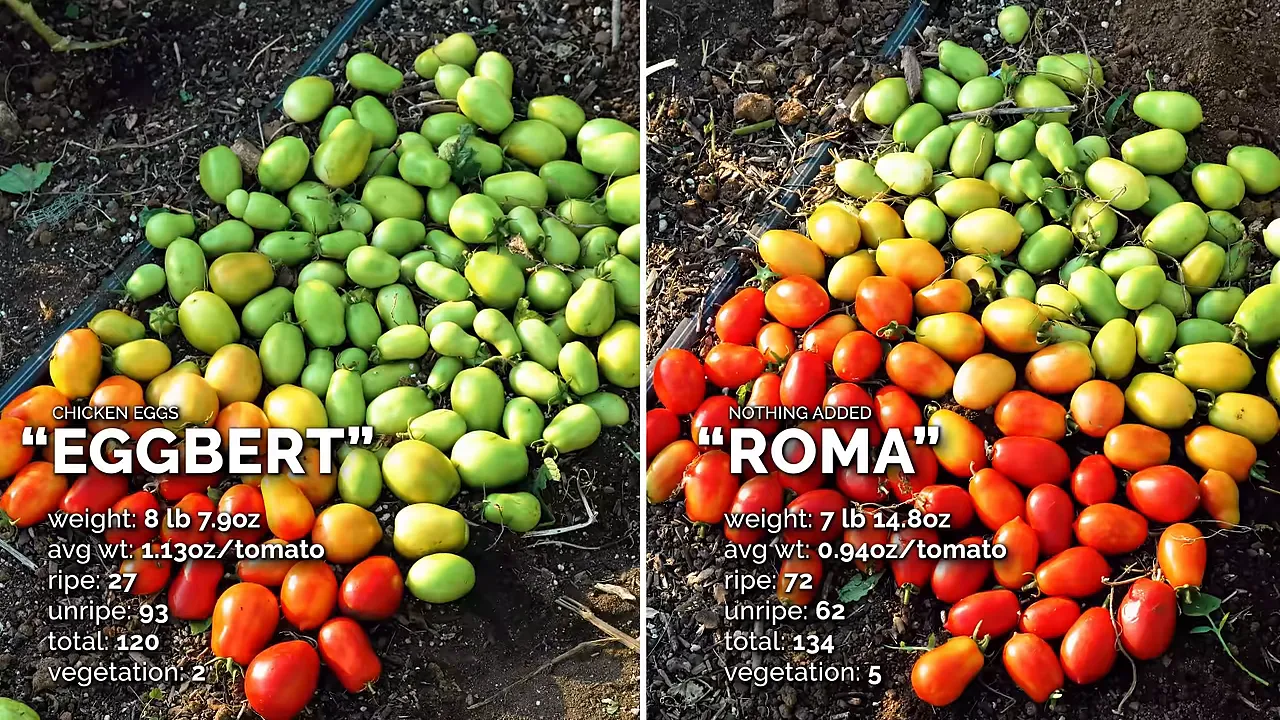
That is a meaningful difference if your goal is tomatoes ready for the kitchen before the season ends.
The control also produced a lot of fruit relative to its fairly modest canopy. The garden-scrap plant had much more foliage, but fewer tomatoes and far fewer ripe ones.
The lesson here is simple: don’t confuse a bigger tomato plant with a better tomato harvest. Count, weight, fruit size, and ripeness tell different parts of the story.
Digging Up the Scraps: What Was Still Underground?
The harvest told us how the plants performed. Excavating the holes helped us understand what had happened to the buried material.
And this is where the fish treatment surprised us all over again.
Prepared leftovers: No recognizable food remained
Under Tahini, we couldn’t find recognizable pasta, beans, or sourdough starter. The contents of the basket looked like soil, with no obvious evidence of the original meal.
The leftovers had visibly disappeared. That did not mean they had improved tomato production.
Garden scraps: Also gone
We found no recognizable weeds or clippings beneath Oxalis either. The buried green material had broken down, and the plant had developed healthy-looking roots.
This treatment had also produced the most foliage aboveground, although not the heaviest or ripest harvest.
Kitchen scraps: Tough pieces and plenty of decomposers
Scrappy’s hole was more varied. Much of the material had disappeared, but eggshell fragments, avocado peel, and pits remained.
There were also visible worms and plenty of pill bugs. We were getting a look at the decomposer community working through the material, with the tougher pieces still recognizable.
That contrast matters. “Kitchen scraps” isn’t one uniform ingredient. Soft trimmings, hard pits, peels, and shells can behave very differently underground.
Eggs: Shells remained, but no intact egg
Eggbert’s planting hole contained lots of eggshell fragments, but we didn’t recover an intact egg. The egg contents were no longer recognizable, and the shell material we handled was fragile.
We couldn’t rule out having accidentally broken the whole egg with a stake earlier in the season. So the excavation didn’t establish exactly when or how it opened.
It did show that plenty of shell material remained after the growing period. Eggbert’s good harvest was not proof that all the shells had quickly become plant-available nutrients.
Fish: Bones, but no recognizable flesh
We expected the catfish remains to be unpleasant. Instead, there was no obvious rotten-fish smell. The flesh was gone, leaving bones, with worms present around the material.
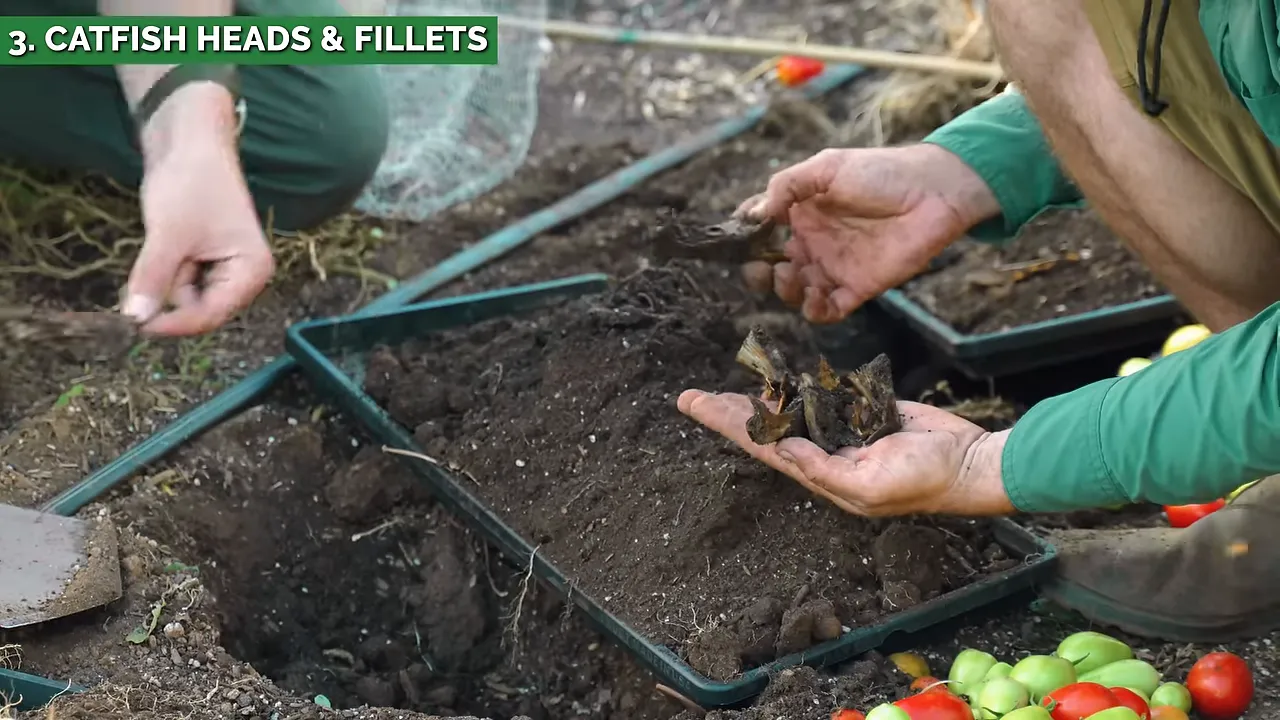
That forced us to refine our initial explanation. It wasn’t simply that the fish never decomposed. The soft tissue clearly had.
The more useful possibility was that the decomposition process itself had temporarily interfered with root growth or nutrient availability. An oxygen-poor pocket around a large mass of decomposing fish could help explain the early setback, even if the material looked thoroughly broken down months later.
Noodle’s roots also looked relatively small compared with the healthier root systems we examined, including Oxalis. That fit our hypothesis, but did not prove the mechanism. We had not measured oxygen, acidity, or nutrient availability over time.
What This Experiment Can and Cannot Tell Us
We made a serious effort to keep the plants, watering, and management consistent. But we still had only one tomato per treatment, in one row, during one growing period.
The seedlings were not perfectly identical. The amendments were different mixtures rather than nutrient-matched treatments. The plants eventually overlapped, and we did not monitor conditions inside the planting holes.
That means these results are useful observations, not a universal ranking of every way to bury food scraps.
We did not test burying scraps months before planting. We did not compare chopped fish with whole heads. And we did not include a finished-compost treatment.
What we did learn was that putting raw organic material beneath a transplant did not automatically improve its harvest. Some treatments performed worse than simply planting in the existing soil, and visible decomposition by the end did not guarantee timely benefits for the crop.
Would I Bury Kitchen Scraps Under Tomatoes Again?
For my own garden, I would keep it simple: plant the tomato and use finished compost rather than burying a collection of raw scraps beneath it.
Composting gives decomposers time to process the material before it goes into the growing space. If you’re building that habit, the EPA’s home composting guide is a useful practical reference.
Jacques was curious enough about Eggbert to consider trying eggs again. Fair enough. It produced the heaviest harvest, and that is worth investigating with more plants. But the control came close on total weight and absolutely dominated on ripe fruit, without using any eggs at all.
The broader lesson is about timing and form. Nutrients inside a food scrap are not necessarily nutrients a tomato can use immediately. Particle size, surface area, and the conditions created during decomposition all deserve attention.
Food scraps can disappear underground without giving the plant above them a better season. For this round, doing less worked remarkably well. No catfish heads required.
If you’d like to grow your own tomatoes, our Botanical Interests seed collection is a place to start. Good luck in the garden, and keep on decomposing.
|


