The first thing that surprised me about growing organic rice in rural Japan wasn't the planting machine, the flooded fields, or even the black paper mulch. It was how far beyond the field you have to go to understand the crop.
Follow the water uphill, and you end up in a forest gorge. Follow the knowledge, and you meet a farmer teaching another farmer a technique that takes years to learn. Follow the harvest, and you might find it in a sushi restaurant, not as the rice under the fish, but as the vinegar seasoning it.
That was the journey with Vince, a former hotel industry professional who traded constant calls and corporate stress for village life and organic rice farming. Naturally, there was also a goat named Momo, who appeared to have the best arrangement of anyone: beautiful countryside, plenty of grass, and humans available to hand out snacks.
Key Takeaways
- Mountain-fed irrigation depends on farmers working together to clear and maintain shared waterways.
- Dense rice seedling root mats make mechanical transplanting possible, but seedling size and health matter.
- Paper mulch suppresses weeds while requiring careful alignment and wide, slow turns during machine planting.
- Daily rice-field care centers on water management, including checking for blockages and leaking paddy banks.
Table of Contents
- Trading City Life for a Village Farm
- Rice Farming Starts With the Water Source
- Growing Rice Seedlings in Trays
- How Paper Mulch Helps Grow Organic Rice
- Planting Rice by Machine
- Planting Rice by Hand in an Experimental Paddy
- The Rice Season Is Mostly Water Management
- Why These Small Rice Fields Matter
- From the Paddy to Rice Vinegar at a Sushi Counter
- A Thanks to Shopify
Trading City Life for a Village Farm
Vince lives in Nakahami, a small village with roughly 30 residents at the time of my visit. The population has been shrinking, and some residents can no longer maintain their growing plots. Alongside his own property, Vince helps care for land that others are unable to manage, including a garden beside the village temple.
Finding this place wasn't an overnight decision. He spent a long time looking for the right village, then worked through the paperwork needed to acquire his property.
His motivation was familiar: burnout. In the hotel business, he was effectively always on standby. A late-night phone call could mean something had gone wrong and he needed to deal with it. He worried about the effects of stress on his health and wanted to reconnect with nature.
Before moving, his growing experience was mostly small balcony gardens. Going from that to managing rice paddies is a pretty serious upgrade.
The property came with houses, paddies, and, rather casually, a couple of mountains. Vince explained that the mountains and their trees were on his title deed, but without a direct access road, he hadn't actually been up there. Owning a mountain you've never visited is quite the flex.
A Small Homestead Around the Rice Fields
At home, Vince keeps a practical vegetable garden focused on what he wants to eat each day. There's a pond with koi and a turtle, three Momiji hens, and an impressive rooster named Toki Hayate, after a sumo wrestler. The name fits.
The hens give him about three eggs a day between them, and the eggs were enormous compared with what I get from my own Buff Orpington. The chickens use an old barn behind the house and move in and out freely.
Even the buildings connect to the rice crop. An old earthen wall incorporates rice straw and local red clay. Vince described maintaining that material by preparing and fermenting the mixture before applying another layer. Rice isn't just something grown nearby. It's part of the fabric of the place.
Then there's Momo, whose name means peach. She comes up to the paddies to graze the grassy banks. Farm help doesn't get much cuter than that.
Rice Farming Starts With the Water Source
On the trip out from Kyoto, I passed field after field of rice. What I hadn't really stopped to ask was: Where does all that water come from?
For Vince's paddies, the answer is a nameless mountain stream deep in the forest. Rainwater collects in the gorge, and the farmers divert part of that flow into the waterways serving the valley. They aren't taking the entire stream, just channeling a portion toward the fields.
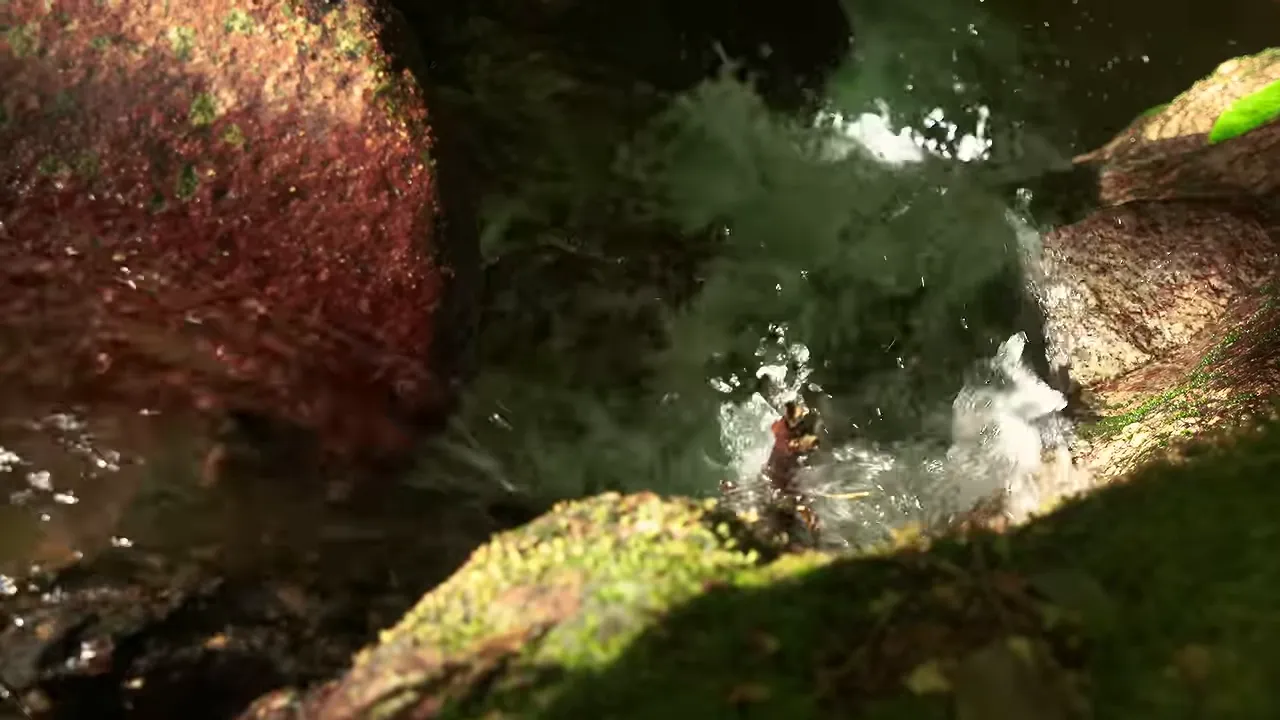
Before planting activities can get underway, the local farmers work together to clear the irrigation channels. Leaves, debris, and accumulated muck have had months to build up. Getting that water flowing again is one of the first communal jobs of the season.
That maintenance doesn't end after the initial cleanup. Channels need regular checks so a blockage doesn't interrupt the supply.
The fields sit at different elevations, with water moving downhill through the terraced landscape and eventually toward the sea. The exact route varies by field. At Vince's experimental coastal plot, for example, he pointed out that water arrived directly from the nearby forest rather than first passing through dozens of other paddies.
Back at a field inlet, the cold water pouring from a small pipe suddenly meant a lot more. That little outlet depended on an entire uphill system, plus the shared work needed to maintain it.
A rice paddy may belong to one farmer, but its water supply connects that farmer to the whole community.
Growing Rice Seedlings in Trays
Before the rice goes into the paddy, it begins as seed. In the nursery system Vince showed me, young seedlings move from an incubator into greenhouse growing areas, where they continue developing in shallow trays.
Rows of bright green seedlings look almost like a lawn. Water from the natural waterways is channeled into the nursery to keep those trays hydrated. The seedlings dry out quickly, so maintaining the supply is important, with occasional watering from above as well.
The Roots Form a Flexible Mat
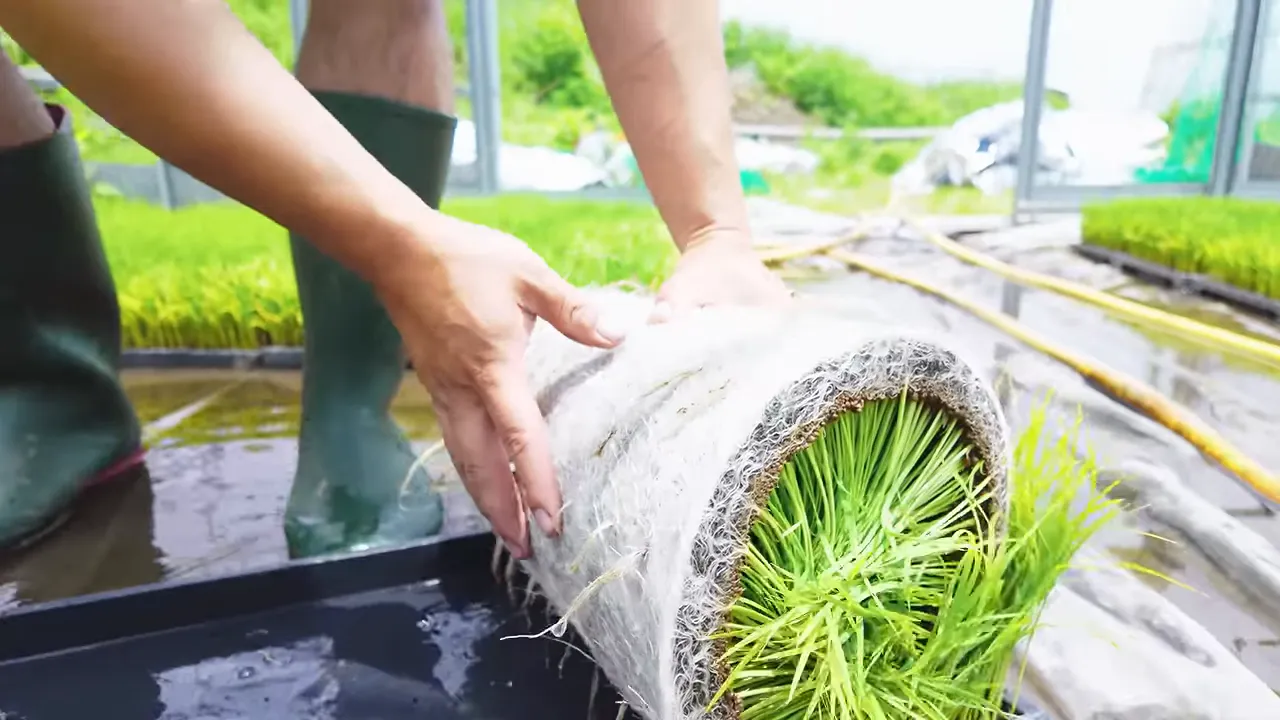
The really cool part is underneath. As the seedlings grow close together, their roots knit through the growing medium and create a dense mat. Instead of handling hundreds of individual plants, you can lift the whole thing.
Vince rolled one up to demonstrate. It looked like a little roll of turf, or an oversized mat of microgreens. That root structure makes it possible to move the seedlings as a unit and load them into a rice transplanter.
Seedling Quality and Timing Matter
The nursery also makes problems relatively easy to spot. Vince looks for uneven patches, yellowing, blotchy growth, and signs of disease. Some trays had white fuzzy growth consistent with mold, while others were vigorous and uniform. Yellowing or poor growth can also point to insufficient nutrition, so an unhealthy patch needs investigation rather than an automatic diagnosis.
Temperature matters in the covered greenhouse, and so does timing. Some older seedlings had grown too tall to fit properly into the planting machine. They could still be used for hand planting, but they were no longer suitable for that mechanical workflow.
The nursery held several rice varieties in separate sections, including rice intended for sake and Koshihikari, a familiar eating-rice variety. Batches were also staggered. An earlier batch had started around April, while another group was being prepared for upcoming planting.
It's a good reminder that successful machine planting starts long before the machine enters the field. The seedlings have to be healthy, manageable, and the right size for the equipment.
How Paper Mulch Helps Grow Organic Rice
At first glance, Vince's planted paddies looked as if they were covered with strips of black plastic. They weren't.
The material is a paper mulch made with carbon and coconut-derived material. Its job is to block light and suppress weeds around the rice seedlings, providing a weed-control method for Vince's organic growing system.
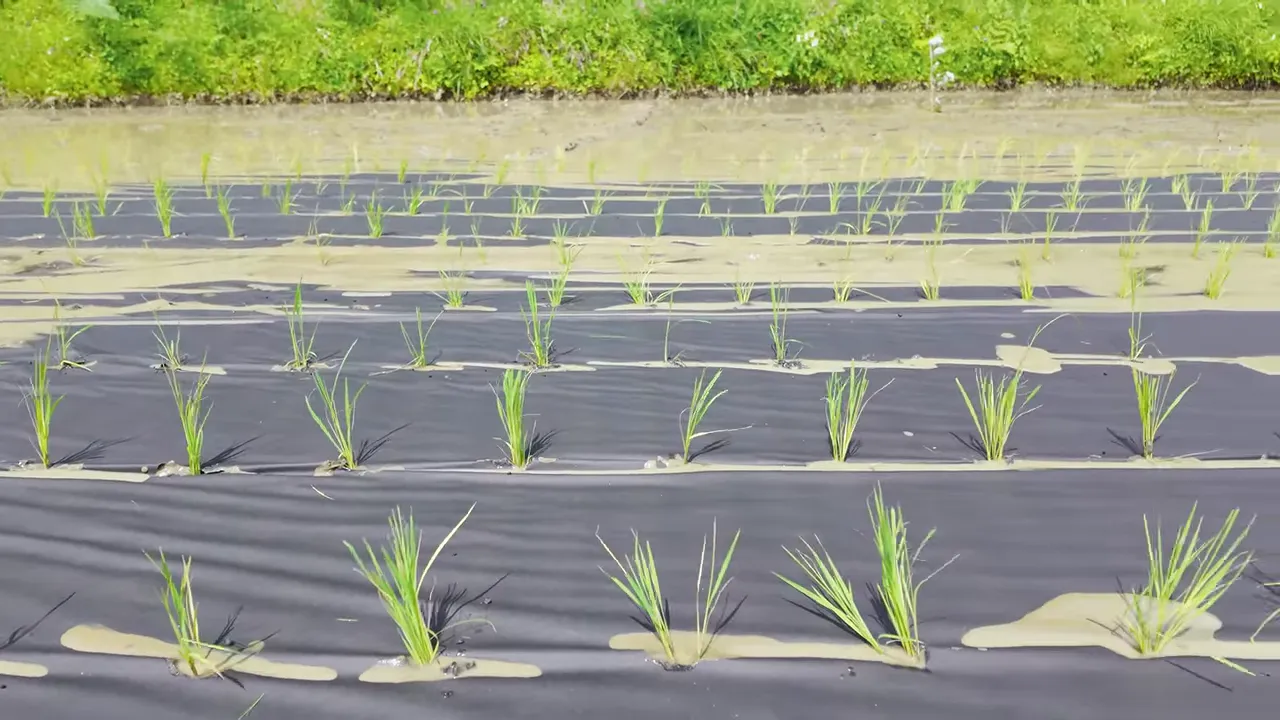
The paper breaks down over time, returning its material to the field rather than requiring removal as a sheet of plastic would. But that useful material also introduces a few complications at planting time.
For one thing, it costs money. The rolls being used were roughly $20 to $30 each, so sloppy alignment means wasted mulch. Before planting, Vince laid out markers using pieces of local vegetation to help guide the machine's passes.
For another, the paper doesn't tolerate sharp turns well. A machine can turn much more tightly than a continuous sheet of wet paper can follow without tearing. That changes how the entire field needs to be planted.
Planting Rice by Machine
Vince learned this paper-mulch technique from his sensei, a farmer living farther up the mountain who practiced it professionally. Vince sought him out specifically because he wanted to learn how to incorporate it into his own organic rice farming.
The planter handles two jobs together: it lays the paper and transplants rice seedlings through it into the soil. Seedling mats sit on the back of the machine, and the planting mechanism takes small groups from those mats as it moves through the paddy.
The clumps we examined contained roughly five or six seedlings each. In what felt like no time, the machine had planted a row about 100 feet long.
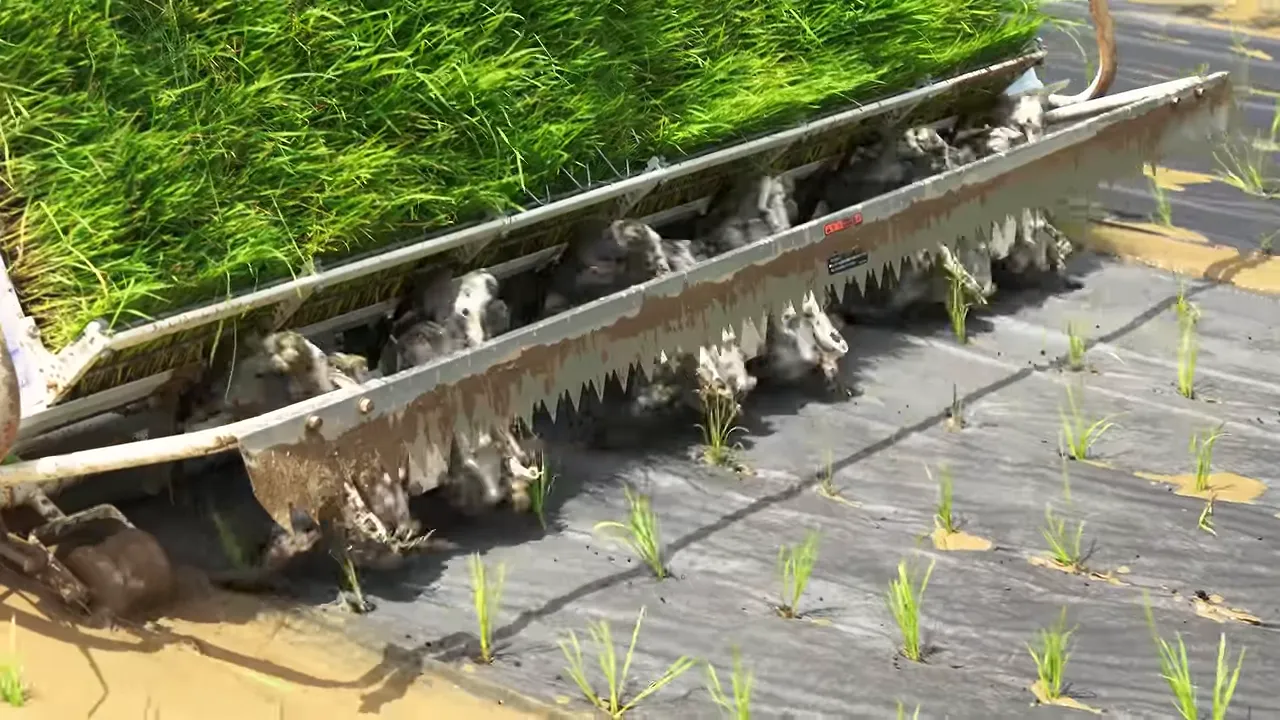
I joined in, but absolutely not as the driver. My job was feeding seedling mats into the machine so it wouldn't run out. Even from that limited role, it became obvious that this was much more complicated than driving in straight lines.
- Plan the route: In this field, the planting sequence began in the middle to avoid driving over areas that had already been planted.
- Keep the seedlings supplied: The machine needs a steady feed of seedling mats.
- Manage the paper: Its alignment and movement have to stay coordinated with the planting mechanism.
- Turn slowly and widely: Tight turns can rip the mulch.
- Track field conditions: Water depth and planting spacing remain part of the job.
The time savings compared with hand planting were enormous. Still, faster doesn't mean effortless. There was constant coordination between Vince and his teacher, with adjustments and practical knowledge passing between them as they worked.
That was one of my favorite parts of the day. The machinery was impressive, but the knowledge behind it was what made the system work. Vince was quick to say he was still learning. This wasn't a technique he'd mastered after a few passes.
Planting Rice by Hand in an Experimental Paddy
After finishing the machine-planted field, we headed to a smaller experimental paddy near the coast. This time, I was getting into the water.
Honestly, it felt great. Whether my back would have agreed after an entire day is another question.
We used leftover seedlings, separating small groups from the mat rather than planting one seedling at a time. Vince suggested about three or four seedlings per clump for the hand planting we were doing.
Spacing depends on the rice variety. His general range was 15 to 30 centimeters between planting positions, although this experimental plot didn't call for perfectly measured rows.
Vince's Five-Clump Planting Rhythm
Instead of working straight down a long row, Vince demonstrated a widthwise pattern that let us place five clumps within reach before moving along.
- Hold a supply of seedlings in one hand.
- Separate a small group of about three or four seedlings.
- Plant the first clump in the middle of your working area as a spacing reference.
- Place the remaining clumps to either side, pressing the roots through the water into the muddy soil.
- Move along and repeat the pattern.
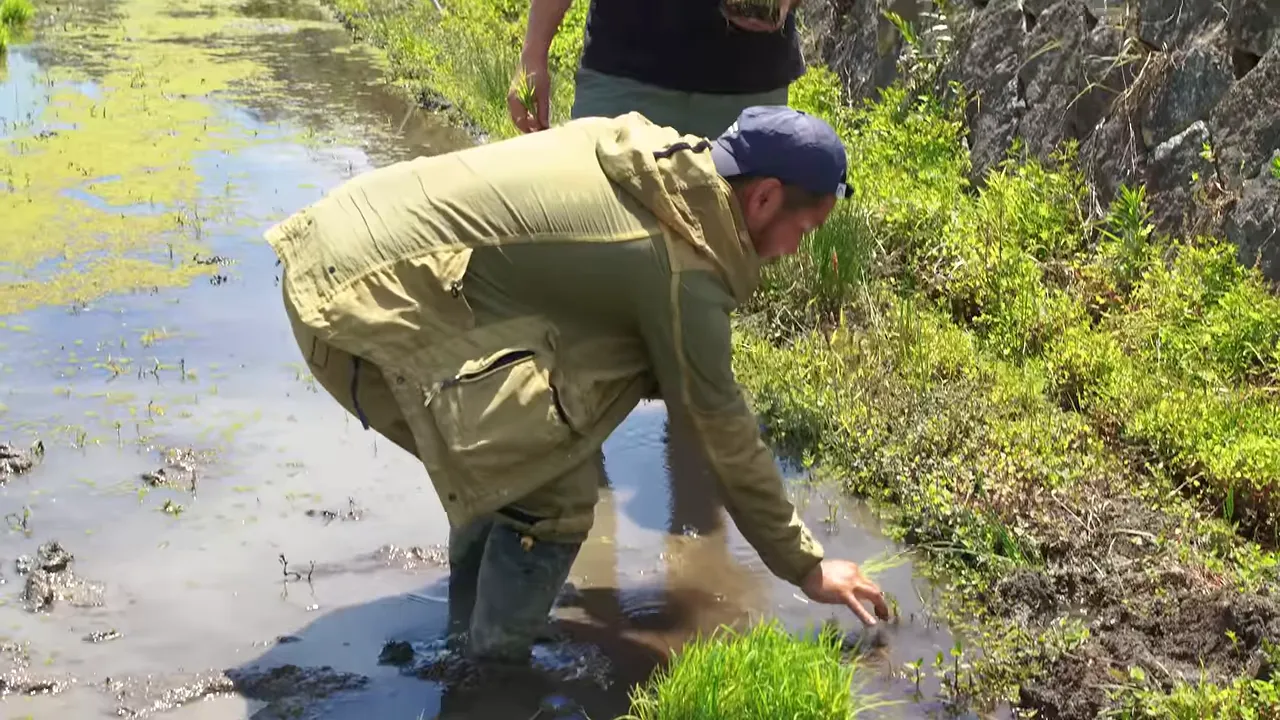
Once the movement clicked, it became a satisfying rhythm: separate, plant, repeat. But it also made the value of the transplanter very clear. Vince reckoned hand planting one of his larger fields could take an entire day.
The two methods also gave the leftover nursery plants different possibilities. Seedlings that were too tall for the machine could still have a use in a hand-planted plot.
The Rice Season Is Mostly Water Management
For Vince's local growing cycle, work begins around March, with seedlings generally ready for field planting around May or afterward. The whole season lasts roughly half a year, sometimes a little longer.
Planting and harvest are the two most demanding periods. Both require preparation, good timing, and a lot of work, with plenty that can go wrong.
Between those peaks, rice is more of a management crop than something like a tomato that needs regular pruning. That doesn't mean it can be ignored. It means the daily attention shifts heavily toward water.
Vince explained that farmers commonly check their paddies every morning and every evening. A healthy-looking field can still have a blocked inlet or an unexpected leak.
Pests Can Damage the Water System, Too
The problems aren't limited to animals eating rice plants:
- Deer: Vince considers them the most troublesome pest in his fields.
- Birds: In direct-sown systems, particularly dry-growing approaches, birds can eat the seed before it establishes.
- Moles: Tunnels in paddy banks can create leaks, sending water out of the field or into the next paddy.
That last problem really stuck with me. An animal doesn't have to touch the crop to cause serious trouble. Breaking the bank that holds the water can disrupt the entire field.
Why These Small Rice Fields Matter
The patchwork of paddies across rural Japan isn't necessarily a landscape of full-time commercial farmers. Vince explained that many are family plots tended alongside other jobs or businesses.
A household may grow rice for its own use, then sell extra through Japan's agricultural cooperative system, commonly known as JA, or directly to friends and family. A small paddy beside a rural home may be part of that household's food supply rather than its sole livelihood.
That helps explain why keeping land in use matters so much in a shrinking village. Maintaining a plot also means maintaining the water channels, the banks, and the knowledge needed to grow there.
A Crop With Deep Historical Roots
As we planted, the conversation stretched much farther back than the current season. Wet-rice agriculture helped reshape Japanese society, supporting more settled communities, stored food, and increasingly complex political organization.
Before its spread, Jomon communities relied heavily on hunting, gathering, and fishing, alongside forms of cultivation. People arriving from mainland Asia through the Korean Peninsula brought wet-rice farming practices that became central to later life in Japan. The Metropolitan Museum of Art's overview of Yayoi culture offers useful background on that transition.
Vince also described the area's ancient Tango connections and trade with the Korean Peninsula. Large burial mounds, known as kofun, are part of the region's archaeological landscape and evidence of its powerful early elites.
It's quite a thing to be standing in a muddy field, separating seedlings with your fingers, while talking about how this crop helped people build permanent communities. The shared irrigation work we'd just seen made that connection feel very tangible.
From the Paddy to Rice Vinegar at a Sushi Counter
Our final stop was Nishimura, where Chef Ricardo uses vinegar made with rice that includes Vince's harvest.
That distinction matters: the connection to Vince's farm was the rice vinegar, not necessarily the grains of sushi rice on the plate. His crop takes another route from field to table, becoming part of the seasoning that helps make the meal.
The sushi course came with a wonderfully urgent instruction: eat each piece within about three seconds of it reaching the plate. After a day tracing water through the forest, lifting seedling mats, feeding a planter, and bending over in a paddy, I wasn't going to argue.
Vince says he's satisfied with the life he's built and can't imagine returning to his old routine. He plans to keep doing it for as long as it remains fun and exciting.
His days are hardly free of responsibility. They're full of water checks, planting decisions, machinery, pests, and a skill set he expects to keep learning. But the work now connects him to the land, his neighbors, and the food at the end of the process.
That's what stayed with me most. Growing organic rice here isn't just about putting a plant in mud. It's about caring for everything that allows that plant to grow.
A Thanks to Shopify
Shopify sponsored this trip and has been part of how we run Epic Gardening for more than six years. After acquiring Botanical Interests, we moved its online store to Shopify so our team could make changes directly and build features such as custom seed filtering without relying on a provider for every update. If you're building a business selling products or services online or in person, a free trial is available through our sponsor link.


